How to Get Your Cat to Let You Pick Her Up
If you've ever bent down to scoop up your cat and watched her vanish like a tiny furry magician, you are very much not alone.
Some cats act like being picked up is a personal betrayal of the highest order.
And honestly? If your cat is aloof, suspicious, or just deeply committed to her own boundaries, that reaction makes perfect sense.
The good news is that this is usually not a "my cat hates me forever and is plotting my demise" problem. It's much more often a trust, timing, and handling problem.
When you change how the interaction happens, many cats become far more willing to tolerate it—and some even learn to enjoy it (I know, shocking).
In this post, I'll walk you through a few simple, research-backed ways to help your cat feel safer being picked up.
These are small shifts, but they can make a ridiculously big difference.
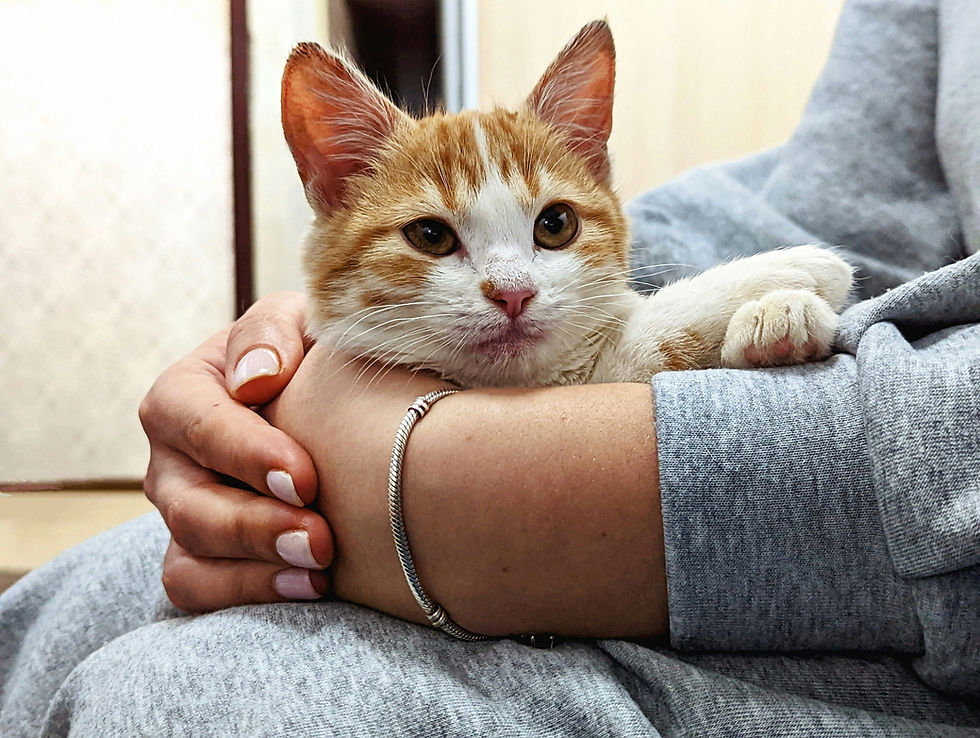
Why cats resist being picked up
Before we get into the how-to, it helps to know what your cat may be feeling.
Being lifted off the ground takes away control. It removes her escape route. And if it happens when she wasn't ready? It can feel scary fast.
That means the goal is not to "teach her who's boss" (spoiler alert: she already knows who's boss, and it's not you).
The goal is to make being picked up feel predictable, brief, and safe.
How to get cat to let me pick her up: 5 gentle tips
1. Let her make the first move
If your cat is giving you the cold shoulder, this one matters more than people think. Wait for her to come to you before you try any handling.
A cat who approaches with her tail up, ears forward, and soft eyes is telling you she's open to contact.
A cat who is hiding, crouched, flicking her tail, or staring you down like a disapproving landlord?
Not so much.
Starting when she feels social keeps the whole interaction from beginning with a trust violation.
This sounds almost too simple, but it changes everything. A lot of aloof cats aren't anti-affection—they're anti-surprise.
2. Pair being picked up with absurdly good treats
Cats learn through association (they're smart like that).
So if "human hand under belly" predicts "best snack of my life," your cat can start to feel very differently about the whole situation.
Start tiny. Reward her for staying relaxed while you touch her sides. Then reward her when your hand slides gently underneath her.
Then reward one tiny lift. Then back down. Think baby steps, not dramatic movie montage where everything transforms in 90 seconds.
The trick is to keep the scary part small enough that she can stay calm. If she gets tense, you went too far too fast (I've been there).
This is one of those things that seems almost too basic, but when you do it in the right order, it works beautifully.
3. Keep sessions short enough to feel boring
This is where a lot of us mess up spectacularly.
We get one good cuddle moment and think, "Amazing, this is our life now," and then we hold on too long. Your cat would like to file a formal complaint with management.
Short sessions work better than long ones. Lift, support, treat, and put her down before she starts squirming. Done. That's the session.
A calm 30 to 60 seconds once a day builds more trust than one overambitious cuddle marathon on Sunday (trust me on this one).
Predictability helps too. When your cat learns, "I get picked up, nothing weird happens, I go right back down," the dread starts to fade.
4. Watch her ears and tail, not your hopes and dreams
Cats are generous with body language. We just tend to ignore it when we really want a snuggle (guilty as charged).
If her ears flatten, her pupils go wide, her tail starts swishing, her body stiffens, or she lifts a paw like she's considering legal action, stop there.
Those are early stress signals. Waiting until she wriggles, scratches, or launches herself away like a furry missile means you missed the earlier, quieter "no thanks."
This matters because every stressful pickup teaches her to expect the next one to be stressful too. But every time you notice her signals and back off?
You teach her that you listen. For aloof cats, that kind of respect is pure bonding gold.
5. Always give her a safe exit
One big reason cats panic when held is that they feel trapped.
You can ease that by making the whole experience feel physically secure and easy to escape (revolutionary concept, I know).
Crouch low before lifting her so the distance from the ground feels less dramatic. Use both hands so her body is fully supported, especially her back end.
Avoid letting her legs dangle like she's in some kind of terrible theme park ride designed by someone who hates cats.
And most important: if she signals discomfort, put her down right away. Not after one more kiss. Not after telling her she's being ridiculous.
Right away. Cats often become more tolerant when they learn that being held doesn't mean losing all control forever.
A simple routine that makes these tips easier to use
The tricky part isn't understanding these tips.
The tricky part is doing them in the right order, consistently, without accidentally pushing too far one day and undoing your progress the next (we've all been there).
That's why a short daily routine helps so much.
A few calm minutes of approach, reward, gentle handling, and respectful release can do more for your relationship than random bursts of "come here, I love you" energy (though your enthusiasm is adorable).
If these tips are clicking for you, that's exactly the idea behind 15 Minutes to Make Your Aloof Cat Fall in Love With You.
It pulls these trust-building steps into a simple daily rhythm, so you're not guessing what to do next.
What not to do if you want your cat to trust you
Just as important as the right steps are the wrong ones (learned this the hard way).
If you want your cat to relax about being picked up, try not to:
Scoop her up when she's hiding or trying to leave
Hold her longer because "she needs to get used to it"
Reward only after she panics
Ignore tail flicks, stiff posture, or flattened ears
Let her dangle without full support
None of that makes you a bad cat parent. It just means you're human, and most of us were never taught that cat trust is built more through consent than persistence.
What progress usually looks like
Progress with an aloof cat is often hilariously subtle. It may not look like instant lap naps and soulful eye contact by Tuesday (I wish it did).
It may look like:
She walks toward you instead of away
She stays relaxed when your hand slides under her
She tolerates a quick lift without stiffening
She asks to come back for another treat
She recovers quickly after being put down
That still counts. In fact, that's the stuff that comes first—and it's honestly pretty magical when you notice it.
Final thoughts on how to get cat to let me pick her up
If you want your cat to let you pick her up, think less about convincing and more about cooperation. Let her approach first.
Pair handling with great rewards. Keep sessions short. Watch her signals. And always let her know she has a safe way out.
That's how trust grows with cats, especially the gloriously standoffish ones who make you work for every moment of affection.
And if you want those steps organized into a simple, repeatable plan, 15 Minutes to Make Your Aloof Cat Fall in Love With You was made for exactly that.
It takes these kinds of trust-building techniques and turns them into an easy daily routine you can actually stick to.
Because the dream isn't just picking your cat up without drama.
The dream is a cat who sees you coming and thinks, "Oh good. It's you." <3



Comments